|
|
|
|
|
|
"If you thought that science was certain — well, that is just an error on your part." Richard Feynman
|
|
|
| |
|
|

|
|
|
| |
|
|
Introduction |
|
|
| |
|
|
Plasma Cosmology |
|
|
| |
|
|
|
The purpose of this website is to introduce the Plasma Universe paradigm and explore its wider implications, encouraging
readers to reconsider familiar evidence within a broader conceptual framework.
A new view of a connected, fractal, and dynamic cosmos is coming into focus — a universe shaped not only by gravity, but also by
organising electromagnetic processes operating in plasma, the electrically conductive state of ordinary matter that accounts for more
than 99 per cent of the observable universe. In many respects, it is a universe that behaves less like a passive machine and more like
a continuously evolving system, leading some to describe it as a living universe.
Plasma cosmology does not reject gravity. Instead, it proposes that electromagnetism — the dominant force governing plasma
behaviour in both laboratory and space environments — plays a fundamental role in the architecture of the cosmos, from the immense
filamentary networks that lace the observable universe to phenomena commonly interpreted primarily through gravity, including
black holes. Its large-scale influence, it argues, has been systematically
underestimated.
The history of science is marked by revision, refinement, and occasional paradigm shifts. Contemporary debates in
cosmology should be understood in that spirit. As new evidence emerges and observational capabilities expand, long-standing assumptions
deserve to be re-examined.
|
|
"A new scientific truth does not triumph by convincing its opponents and making them see the light, but rather because its opponents eventually die, and a new generation grows up that is familiar with it."
Max Planck
|
|
| |
|
|
|
|
|
|
| Search the Plasma Cosmology library: |
|
|
|
|
|
| New YouTube Channel, Dissonant Dragon |
|
|
| |
|
|
|
Click this link for my new YouTube channel,
Dissonant Dragon.
|
|

|
| |
|
|
| Substack Essays |
|
|
| |
|
|
Long-form essays examining plasma cosmology and modern cosmological assumptions.
|
|
|
| |
|
|
| What is Plasma? |
|
|
| |
|
|
|
Plasma is the fourth state of matter. It differs from solids, liquids and gases in so far as its atoms are divided into free-floating 'negative' electrons and 'positive' ions (an atom which has lost its electron/s). It is sometimes referred to as an ionized gas. Students are generally taught about only three states of matter, and when plasma does get a mention, little importance is assigned. Not only should plasma be added to the list, but the order should be reversed to put it in first place. The reasons for this will become clear.
The term plasma was borrowed from blood plasma in order to describe its almost life-like and self-organising properties.
Plasmas can emit light when under the excitation of electrical and magnetic fields. Polar auroras bear witness to this fact.
|
|

|
| |
|
|
| Where is it? |
|
|
| |
|
|
|
Plasma is almost everywhere. At least ninety-nine percent of the known universe is, in fact, matter in its plasma state! The surface of the sun is plasma; not hot gas, which is quite a different thing.
"The forthcoming scientific revolution is presaged by the rapid pace of discoveries about our own star, the Sun, and its total plasma environment."
Plasmas.org
Plasmas in space consist entirely of ions and electrons, and are thus very energetic or 'hot'. Only when cooled do they form the matter to which we are familiar here on Earth: solids, liquids, and gases. Because plasmas remain electrically charged in space, they are influenced more by electromagnetic forces than gravity. In fact space, once considered mostly empty, has been found to be alive with plasma. Vast flows of charged particles have been discovered spanning hundreds-of-thousands of light years across interstellar space.
The most familiar examples of electrical plasmas here on earth are neon signs and lighting, television screens, and electrical arc welding machines. Fire and Lightning are also forms of Plasma.
|
|

|
| |
|
|
| What does it do? |
|
|
| |
|
|
|
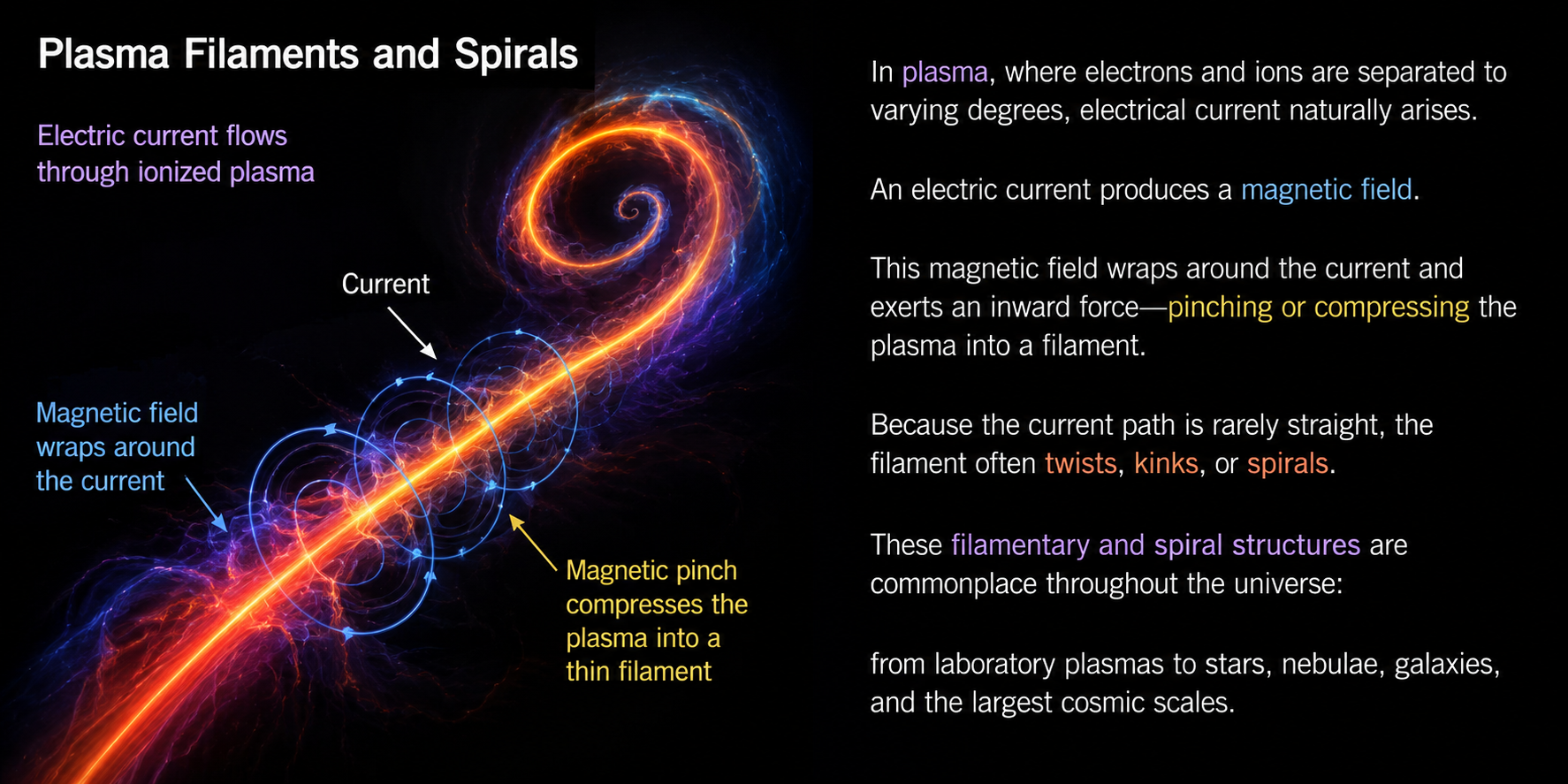
Just about everything! Plasma is an excellent conductor of electricity, and because it contains freely moving
electrons and ions, its electrical conductivity far exceeds that of copper or gold. Through its interaction with electric
currents and magnetic fields, plasma exhibits a richness of structure unlike that of solids, liquids, or gases. It naturally
forms cellular, filamentary, and spiral patterns.
These structures arise because electric currents generate magnetic fields, which compress, or
pinch, the flowing plasma into narrow filaments. The filaments often twist into spirals and are observed on scales ranging
from laboratory plasmas to the largest known structures in the universe.
Pictured right is a novelty plasma-lamp typical of those available on the high street.
|
|
|
| |
|
|
| Mainstream Perspectives |
|
|
| |
|
|
|
Conventional astronomy has made remarkable progress in mapping the
plasma universe. Magnetic fields, solar winds, magnetospheres and
ionised environments are now observed throughout the Solar System
and far beyond. In many areas, the language used to describe these
phenomena naturally draws upon the familiar concepts of fluid dynamics.
Terms such as solar wind, electron rain,
ion storms, bow shocks, and
plasma clouds provide intuitive ways of visualising highly
complex behaviour.
These descriptions are both useful and appropriate. Plasma often
behaves collectively, and fluid models successfully describe many
large-scale phenomena. At the same time, plasma is not merely a
fluid. It is an electrically conducting medium capable of sustaining
electric currents, double layers, charge separation, and other
collective electromagnetic effects that have no direct counterpart
in ordinary fluids.
It is worth remembering that the foundations of modern cosmology
were laid before the space age, when direct measurements of cosmic
plasma were impossible. At that time, the Milky Way itself was often
regarded as the entire observable universe, and the electrical
properties of plasma remained largely unexplored. Since then,
spacecraft have revealed that plasma dominates the visible universe,
and that electromagnetic interactions occur wherever plasma exists.
Plasma cosmology does not reject the achievements of gravitational
theory. Rather, it asks whether the extraordinary advances in plasma
physics and space exploration justify a corresponding expansion in
our explanatory framework. Scientific theories are provisional by
design. Their strength lies not in remaining unchanged, but in
adapting to new observations.
"Students using astrophysical textbooks remain
essentially ignorant of even the existence of plasma concepts,
despite the fact that some of them have been known for half a
century..."
Hannes Alfvén
"Men occasionally stumble over the truth, but
most of them pick themselves up and carry on as if nothing ever
happened."
Winston Churchill
One area in which these differing emphases become particularly
apparent is the study of comets. Once described
simply as "dirty snowballs" sublimating under solar heating, comets
are now known to interact dynamically with the solar wind and the
surrounding plasma environment. Electric currents, plasma sheaths,
double layers, and electromagnetic interactions have all been
measured directly by spacecraft.
These are not peripheral details; they are fundamental aspects of
cometary physics. Whatever interpretative framework one ultimately
favours, modern comet science cannot be understood without plasma
physics. For a fuller discussion, see the section on Electric Comets.
|
|
"It is an embarrassment that the dominant forms of matter in the universe remain hypothetical!"
Jim Peebles |
| |
|
|
| The role of Plasma in The Universe |
|
|
| |
|
|
|
Plasma cosmology is not limited to hypothesis and philosophical critique. While direct experimentation on universal scales is, of course, impossible, plasma behaviour is known to be highly scalable. Laboratory discharges, planetary magnetospheres, solar phenomena, and galactic structures exhibit recurring filamentary and pinch-like morphologies across vast ranges of magnitude.
Advances in supercomputing have enabled increasingly sophisticated simulations of plasma dynamics on galactic scales, often employing a relatively small set of well-understood electromagnetic equations. These models reproduce filamentation, current sheets, and collimated structures that bear resemblance to observed large-scale cosmic features.
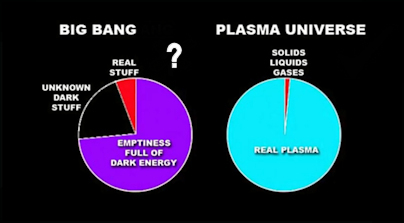
By contrast, standard cosmological models rely on additional components including dark matter and dark energy to account for galactic rotation curves, large-scale structure formation, and cosmic acceleration. Whether these constructs represent new forms of matter and energy or indicate gaps in current understanding remains an open question within contemporary research.
"Dark Matter and Dark Energy are the blank cheques required to postpone the falsification of bankrupt theories."
Thunderbolts Project, circa 2005
Such critiques express a concern that increasingly complex theoretical additions may reflect unresolved tensions within prevailing models. Plasma cosmology proposes an alternative emphasis: that electromagnetism — the dominant force in laboratory plasma environments — plays a foundational role in shaping cosmic structure.
The question is not whether gravity operates, but whether a gravity-only framework is sufficient to explain the richness of observed cosmic morphology.
|
|

|
| |
|
Were Sherlock Holmes a Cosmologist, he might have said: "It's Filamentary my Dear Watson."
|
|
| A picture can say a thousand words |
|
|
| |
|
|
|
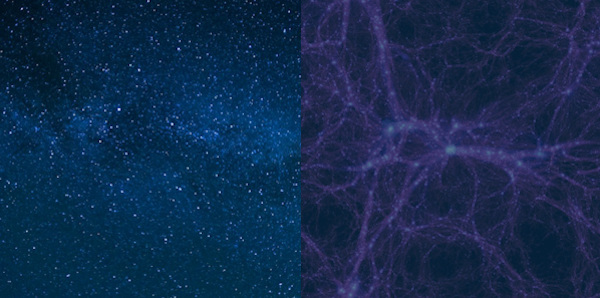
The Milky Way galaxy pictured through a standard telescope, left, and a radio telescope, right, revealing its filamentary structure. No dark matter required.
|
|
"The underlying assumptions of cosmologists today are developed with the most sophisticated mathematical methods and it is only the plasma itself which does not 'understand' how beautiful the theories are and absolutely refuses to obey them."
Hannes Alfvén
|
| |
|
|
| Gravity vis-à-vis Electromagnetism |
|
|
| |
|
|
| Attracts |
|
Attracts and repels (connected) |
| Inverse square law |
|
Inverse square law |
| Surrounds objects |
|
Surrounds objects |
| Cannot be shielded |
|
Can be shielded (?) |
| Incredibly weak |
|
Enormously strong |
| |
|
|
|
|
"What we know is a drop, what we don't know is an ocean." Isaac Newton
|
|
Electromagnetism, the force we know best, is 10 to the 39th power stronger. That is 10,000,000,000,000,000,000,000,000,000,000,000,000,000,000 stronger!
|
|
|
| |
|
|
Too many remain ob-li-vious to the obvious. The li is that the universe is dominated by gravity alone.
|
|
|
| |
|
|
| Back to the Future | |
|
| |
|
|
|
There is little that is entirely new about many of the ideas expressed on this site. At the beginning of the twentieth century, several leading scientists regarded electromagnetism as central to the future of astronomy and cosmology, and as potentially relevant to a deeper understanding of gravity itself.
Today, introductory treatments often present electromagnetism and gravity as fundamentally unrelated, noting that electromagnetic effects can be shielded whereas gravity cannot. It is also frequently remarked that the magnetic force of a hand-held magnet is negligible when compared with the gravitational pull of an entire planet.
Such comparisons, while illustrative at one level, may obscure important distinctions. Electromagnetic forces operate between charges and currents; gravitational forces operate between masses. Comparing a small laboratory magnet to an entire planet does not exhaust the range of electromagnetic phenomena observed in plasma environments, where large-scale currents and collective behaviour can dominate dynamics.
"...the underlying assumptions of cosmologists today are developed with the most sophisticated mathematical methods and it is only the plasma itself which does not 'understand' how beautiful the theories are and absolutely refuses to obey them."
Hannes Alfvén
During the twentieth century, theoretical physics increasingly relied on highly abstract mathematical frameworks. This shift produced extraordinary successes. Yet as Hannes Alfvén repeatedly emphasised, plasma behaviour in laboratory and space environments often resists overly simplified assumptions. His critique was not of mathematics itself, but of allowing mathematical elegance to substitute for empirical grounding.
|
|
"Physics is mathematical not because we know so much about the physical world, but because we know so little."
Bertrand Russell
|
| |
|
|
On Sources and Interpretation |
|
|
| |
|
|
Wikipedia is a useful reference for established knowledge, but it is not a neutral arbiter of scientific truth. Its consensus-driven model tends to reinforce prevailing views, sometimes at the expense of emerging or unconventional ideas.
Readers are encouraged to approach all sources with critical thinking and to compare perspectives where possible. |
|
|
| |
|
|
| Ideas, Institutions, and Inertia |
|
|
|
|
|
|
Cosmology is often described as the Queen of the Sciences because it provides a conceptual framework within which much of physics operates. Its conclusions influence astrophysics, particle physics, and even philosophy. Such centrality naturally brings intellectual weight and, inevitably, institutional inertia.
Science thrives on adventure and revision. Yet modern research also operates within systems of funding, career structures, and reputational investment. When large theoretical frameworks become deeply embedded, change can be slow not necessarily because of malice, but because of the human tendency to defend what is familiar and professionally established.
Consider the following contrasting statements:
"A cosmic jet 2 billion light years away is carrying the highest electric current ever seen: 10^18 amps, equivalent to a trillion bolts of lightning."
NewScientist.com, 2011
"The jets have been shown not to be electric currents; the energy and the physics involved are certainly not electromagnetic."
Phys.org, 2011
The tension between these perspectives highlights a broader issue. Electromagnetic language is often used descriptively, yet
when it challenges gravity's dominant role, it is frequently dismissed. A more complete account should explain how these views
are reconciled.
Opening the discussion to plasma physics and large-scale electromagnetic structure does not diminish gravity. It simply asks
whether gravity acts alone.
Plasma cosmology does not claim to have all the answers. It argues that electromagnetism — the dominant force governing
plasma in the laboratory — plays a far greater role in the universe than is currently acknowledged.
Science advances by following the evidence. Sometimes that means refining existing ideas. Occasionally, it means rethinking
them. If cosmology is approaching such a moment, the outcome must be decided not by authority or consensus, but by the
evidence itself.
"What we thought we understood of planetary nebulae we no longer do. Something different and dramatic is going on."
Raghavendra Sahai, PhD
Astronomer
Principal Research Scientist
JPL/Caltech
Support Independent Research
If you have enjoyed my website, articles, or videos and would like to
support future research, you can buy me a coffee using the button
below or by scanning the QR code. Thank you.
Privacy & Cookies Policy
© 2005–2026 PlasmaCosmology.net
Questioning assumptions. Following the evidence.
|
|
“Today’s scientists have substituted mathematics for experiments, and they wander off through equation after equation, and eventually build a structure which has no relation to reality.”
Nikola Tesla
"It is easier to fool someone than to convince them they have been fooled."
Anon
|
|
|
|
|
|
|
|
|