 | | |
|
The Return of the Æther
|
|
|
| |
|
|
| What Is Empty Space? |
|
|
| |
|
|
|
For more than a century, we have been told that empty space is, well, empty.
Not quite nothing, perhaps. But certainly no substance. No medium. No hidden structure.
The old concept of the Æther, once regarded as essential to understanding light, electricity and magnetism, was supposedly swept aside by the Michelson-Morley experiment and Einstein's theory of relativity.
The verdict, we are told, is settled.
Case closed. Or is it?
The trouble is, the deeper modern physics explores reality, the stranger empty space appears to become.
- Quantum fields
- Zero-point energy
- Vacuum fluctuations
- Virtual particles
- The Higgs field
- Dark energy
Space itself is now understood to possess measurable physical properties. It is no longer merely an empty stage upon which matter performs, but something far richer and more mysterious.
Curiously, many of these ideas bear a striking resemblance to properties once attributed to the classical Æther.
Has modern physics quietly rediscovered the very thing it thought it had abandoned?
|
|
"According to the general theory of relativity space is endowed with physical qualities; in this sense, therefore, there exists an Æther."
Albert Einstein, Leiden, 1920
|
| What Was the Æther? |
|
|
| | | |
|
Today, the very word Æther carries a certain stigma. It conjures images of Victorian gentlemen, improbable mechanical contraptions, and a scientific idea long since abandoned. Mention it today and many physicists will politely smile before changing the subject.
Yet that caricature bears little resemblance to what many of its greatest proponents actually had in mind. The Æther was not imagined as a cloud of invisible gas drifting through space, nor as just another substance among many. Rather, it was conceived as the underlying substrate of physical reality itself — a plenum, a subtle medium, or perhaps simply a vast sea of potential permeating all of space.
The details differed from one physicist to another. There was no single, universally accepted Æther theory. But there was broad agreement on one point.
Nature appeared to require a medium. After all, waves normally propagate through something.
- Sound requires air
- Ocean waves require water
- Seismic waves require rock
- Light, too, was understood as a wave
So what, exactly, was waving?
To many nineteenth-century physicists, the answer seemed almost unavoidable. Some form of all-pervading medium must exist.
James Clerk Maxwell developed his equations of electromagnetism within this intellectual framework. Sir Oliver Lodge considered the Æther indispensable, while Nikola Tesla rejected the idea that electromagnetic waves travelled through absolute nothingness.
The important point is this: The Æther was not introduced to solve a philosophical puzzle. It was introduced because many of the greatest physicists of the nineteenth century believed the evidence required it.
|
|
"The phenomena of electrical discharge are exceedingly important, and when they are better understood they will probably throw great light on the nature of electricity as well as on the nature of gases and of the medium pervading space."
James Clerk Maxwell, A Treatise on Electricity and Magnetism
|
| |
|
|
| |
|
|
| Michelson and Morley — The Experiment That Changed the Debate |
|
|
| | | |
|
If there is one experiment said to have buried the Æther, it is the Michelson-Morley experiment of 1887.
Michelson and Morley expected that, as the Earth travelled through space, light moving in the direction of that motion would behave slightly differently from light travelling at right angles to it. Using one of the most sensitive optical instruments ever constructed, they attempted to detect that tiny difference. The result was certainly unexpected, but it was not quite what later generations often claimed.
Contrary to popular belief, Michelson and Morley did not report an exact zero. They measured a displacement far smaller than expected. Small enough to cast serious doubt on the simplest Æther models, but not necessarily every possible form of underlying medium.
Several explanations were proposed. Perhaps no Æther existed. Perhaps the Earth carried the surrounding medium with it. Or perhaps matter itself contracted as it moved through the Æther, precisely compensating for the expected effect.
The experiment raised profound questions. It did not answer all of them.
Over time, however, a far simpler narrative took hold — the Æther had been disproved.
Yet history has a habit of becoming tidier with each retelling. And in this case, one important chapter was only just beginning.
|
|
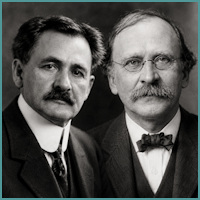 “The indicated effect was not zero...”
Dayton C. Miller |
| |
|
|
| |
|
|
| Dayton Miller |
|
|
| | | |
|
If the Michelson-Morley experiment had truly settled the question, the story would have ended there. It didn’t.
One of the scientists who refused to let the matter rest was the American physicist Dayton C. Miller.
He was a highly respected experimental physicist, renowned for his precision measurements and meticulous methodology. Albert Einstein himself visited Miller's laboratory at the Mount Wilson Observatory to discuss his work.
Over more than two decades, Miller carried out what remains one of the most extensive investigations into Æther drift ever undertaken. He refined Michelson's interferometer and repeated the experiment under different conditions, at different times of day, in different seasons, and at different altitudes. In total, he accumulated hundreds of thousands of individual observations.
Rather than finding no effect at all, Miller consistently reported a small but persistent drift. Although far smaller than classical theories had predicted, he believed it indicated that the Earth was indeed moving through some form of underlying medium.
Einstein recognised the significance of Miller's work. If Miller's observations proved correct, one of the central pillars of relativity would be undermined. As Einstein later wrote:
"If the results of the Miller experiments were to be confirmed, then the theory of relativity could not be maintained..."
— Albert Einstein
It was a remarkable admission. Not because Einstein accepted Miller's conclusions, but because he understood one of the fundamental principles of science.
No theory, however elegant, is above experimental evidence.
As further experiments were conducted, most physicists concluded that Miller's observations were better explained by subtle temperature gradients, mechanical distortions, and other experimental artefacts. His interpretation gradually fell out of favour.
Even so, for more than twenty years, one of the world's foremost experimental physicists believed the question remained open.
That alone should give us pause before accepting a simplified textbook story based on a single experiment in 1887.
|
|
 “It seems to me... that my experiments will invalidate one of the fundamental postulates of the Theory of Relativity...”
Dayton C. Miller |
| |
|
|
| |
|
|
| Paul Marmet — Looking Again at Michelson-Morley |
|
|
| | | |
|
Dayton Miller questioned the accepted interpretation of the Michelson-Morley experiment. Several decades later, another physicist approached the problem from a different direction.
Rather than repeating the experiment, the Canadian physicist Paul Marmet re-examined the mathematics underlying the original analysis.
According to Marmet, the Michelson-Morley calculation omitted two important physical effects. He argued that the motion of the mirrors alters the angle at which light is reflected, while light itself does not enter the moving apparatus at precisely ninety degrees, as Michelson and Morley had assumed.
These were not exotic ideas. They were ordinary consequences of classical optics.
Yet Marmet argued that, once these effects were taken into account, the famous "null result" became exactly what one would expect from a stationary Æther combined with Galilean transformations.
As he concluded:
"When these overlooked phenomena are taken into account, we see that a null result in the Michelson-Morley experiment is the natural consequence..."
— Paul Marmet
His work reminds us that even history's most celebrated experiments remain open to re-examination.
|
|

“Therefore, for the last century, the relativity theory has been based on a misleading calculation.”
Paul Marmet |
| |
|
|
| |
|
|
| Einstein and the Vanishing Æther |
|
|
| | | |
|
By the beginning of the twentieth century, physicists faced an uncomfortable situation. Maxwell's equations had proved spectacularly successful. Electromagnetism worked. The mathematics worked. But the nature of the medium through which electromagnetic waves propagated remained uncertain.
Lorentz and FitzGerald attempted to resolve the Michelson-Morley result without abandoning the Æther. They proposed that objects moving through the medium physically contracted in the direction of motion, precisely compensating for the expected effect.
It was an ingenious solution.
Then, in 1905, Albert Einstein took a radically different approach. Instead of asking how matter behaved while moving through the Æther... he asked whether the Æther was needed at all.
Remarkably, Einstein retained much of Lorentz's mathematics. Length contraction remained. Time dilation remained. The equations remained. What disappeared was the medium itself.
Space no longer required an underlying substance. The Æther quietly vanished from physics.
It was an elegant simplification — and one of the most influential conceptual shifts in the history of science. Yet it also raised an intriguing question. Had the mathematics replaced the mechanism? Or had the mechanism merely been set aside?
Curiously, Einstein himself later revisited the question. In his famous Leiden lecture of 1920 he remarked:
"According to the general theory of relativity space is endowed with physical qualities; in this sense, therefore, there exists an Æther."
— Albert Einstein, Leiden lecture, 1920
This was not the luminiferous Æther of nineteenth-century physics, nor did Einstein abandon relativity. But it did represent an important clarification. Even Einstein no longer regarded space as a featureless void.
Among Einstein's later critics was the British physicist Herbert Dingle, who believed that twentieth-century physics had become increasingly reliant on mathematical description while moving further away from physical explanation.
As Dingle observed:
"...Lorentz, in order to justify his transformation equations, saw the necessity of postulating a physical effect of interaction between moving matter and the aether, to give the mathematics meaning. Physics still had de jure authority over mathematics: it was Einstein, who had no qualms about abolishing the aether and still retaining light waves whose properties were expressed by formulae that were meaningless without it, who was the first to discard physics altogether and propose a wholly mathematical theory..."
— Herbert Dingle, Science at the Cross-Roads.
Equations, however successful, describe behaviour. They do not necessarily reveal the underlying mechanism — or even the nature of reality itself.
Think of the epicycles used to explain planetary motion before Copernicus. They predicted the movements of the planets with remarkable accuracy, yet rested upon a fundamentally mistaken picture of the cosmos. The mathematics worked. The underlying model did not.
|
|
"Experience is not at the command of the arbitrary machinery of logic."
Herbert Dingle
|
| |
|
|
| |
|
|
| What Is Waving? |
|
|
| | | |
|
At the heart of this entire discussion lies a surprisingly simple question: What is waving?
Throughout nature, every wave we encounter propagates through a medium.
- Sound travels through air
- Ocean waves travel through water
- Seismic waves travel through rock
- And plasmas support an astonishing variety of wave phenomena
Remove the medium — and the wave disappears.
James Clerk Maxwell's equations united electricity, magnetism and light into one of the greatest achievements in the history of physics. Yet Maxwell developed those equations within a universe permeated by an underlying medium. For him, the Æther was simply part of the physical picture.
Sir Oliver Lodge agreed. Nikola Tesla went further.
"I consider this extremely important. Light cannot be anything else but a longitudinal disturbance in the Æther..."
— Nikola Tesla
The important point is that some of the greatest electrical thinkers in history considered a medium indispensable.
Modern physics has changed the language. Today, instead of an Æther, we speak of:
- Quantum fields
- Vacuum energy
- Spacetime
Yet one question stubbornly remains: What is waving?
Wave-particle duality tells us how light behaves. It does not necessarily tell us what light is. Nor does it explain why an electron sometimes behaves like a particle and sometimes like a wave.
Richard Feynman famously admitted:
"I think I can safely say that nobody understands quantum mechanics."
— Richard Feynman
Again, the mathematics is extraordinarily successful, but the underlying physical picture remains far less clear.
|
|
"I consider this extremely important. Light cannot be anything else but a longitudinal disturbance in the Æther..."
Nikola Tesla
|
| |
|
|
| |
|
|
| The Double-Slit Mystery |
|
|
| | | |
|
The famous double-slit experiment is one of the clearest illustrations of wave-particle duality. More than two centuries after Thomas Young first demonstrated the phenomenon, it continues to fascinate physicists. Individual particles are detected as discrete impacts, yet when many such impacts accumulate they form an interference pattern characteristic of waves.
Quantum theory predicts the experimental results with extraordinary accuracy, yet their physical interpretation remains the subject of continuing debate.
If light exhibits wave behaviour, then asking whether some underlying medium exists remains a perfectly legitimate scientific question. The experiment does not prove that such a medium exists, but neither does it render the question obsolete. It simply reminds us that, despite the extraordinary success of modern physics, some of the deepest questions about the nature of reality remain open.
|
|
"I think I can safely say that nobody understands quantum mechanics."
Richard Feynman
|
| |
|
|
| |
|
|
| The Quantum Vacuum |
|
|
| | | |
|
Modern physics no longer describes empty space as truly empty.
The vacuum is understood in terms of quantum fields that permeate space and retain fluctuations even in their lowest-energy state. What are commonly described as virtual particles arise within the mathematical framework of quantum field theory, while fields such as the Higgs field are present throughout space.
Few physicists would describe this as an Æther. Yet the contrast with the classical idea of an absolute void is striking. The quantum vacuum has structure, energy and measurable physical properties, and can influence the behaviour of matter and radiation.
|
|
|
| |
|
|
| |
|
|
| The Vacuum That Behaves Like Matter |
|
|
| | | |
|
One striking illustration of these physical properties is vacuum birefringence. Quantum electrodynamics predicts that extremely powerful magnetic fields can affect the propagation of light through otherwise empty space, in a manner resembling the optical behaviour of certain crystals.
Even spacetime itself is increasingly described using language once associated with physical substances. Recent theoretical work has explored what researchers call “critical spacetime crystals” — repeating geometric structures arising in mathematical models of gravitational collapse. These are not crystals in the ordinary material sense. Nevertheless, such ideas illustrate how far modern physics has travelled from the intuitive picture of space as a passive, featureless void.
If supposedly empty space can possess measurable properties and influence the behaviour of light, perhaps the old question has not disappeared at all. It has simply acquired a new vocabulary.
|
|
“The universe is not only stranger than we suppose, but stranger than we can suppose.”
JBS Haldane, Possible Worlds (1927), paraphrased |
| |
|
|
| |
|
|
| The Electron |
|
|
| | | |
|
Despite more than a century of research, the electron remains deeply mysterious.
We know its charge. Its mass. Its spin. Yet, remarkably, we still have no evidence that it possesses any internal structure.
Is it truly fundamental? Or is it a stable pattern emerging from some deeper substrate?
That question is not new. It is worth remembering that not all of the great pioneers of electrical science regarded the electron as the fundamental constituent of electrical phenomena. Thinkers such as Nikola Tesla and Charles Proteus Steinmetz often preferred to describe electrical behaviour in terms of fields and the underlying medium, rather than discrete particles.
The wave-like behaviour demonstrated by electrons only deepens the mystery. Modern physics predicts that behaviour with extraordinary precision. Yet prediction is not necessarily explanation.
It should be noted that questioning whether the electron is fundamental is not the same as denying the observed phenomena. Electron beams, electron diffraction, and electron microscopy are all real. The deeper question is whether the electron is itself a fundamental entity, or the observable manifestation of something more profound.
|
|
|
| |
|
|
| |
|
|
| The Mystery of Magnetism |
|
|
| | | |
|
Electric charge appears everywhere.
Positive, Negative. Protons, Electrons.
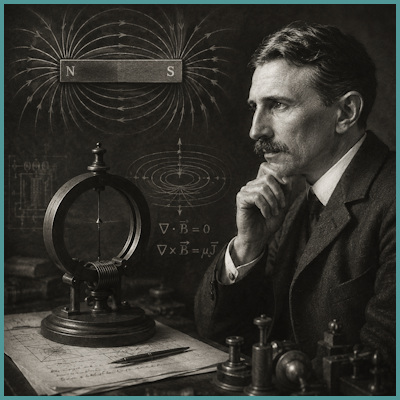
Magnetic charge, however, has never been observed. Maxwell's equations tell us that magnetic fields form closed loops. Break a magnet in half, and both pieces simply produce new north and south poles.
For decades, physicists have searched for magnetic monopoles.
So far... nothing.
Why should nature produce electric charge in abundance, yet apparently no magnetic charge at all?
Perhaps that is telling us something profound. Perhaps magnetism is not a fundamental entity in its own right, but the manifestation of something deeper.
|
|
 |
| |
|
|
| |
|
|
| The Fifth Element |
|
|
| | | |
|
Long before the rise of modern science, philosophers attempted to understand the universe in much the same way we do today.
What is everything made of?
The ancient Greeks famously proposed four fundamental elements.
Yet many also believed there was a fifth. Aristotle called it quintessence. Others knew it simply as the Æther — the subtle substance believed to fill the heavens beyond the Earth. It was not regarded as just another material. It was the medium from which the cosmos itself was formed.
Remarkably, similar ideas appear in many cultures. In Indian philosophy, Akasha was often described as the most subtle of the elements — the underlying field from which all forms emerge. Other traditions likewise spoke of an invisible substance permeating and connecting the universe.
It would be a mistake to read modern physics into these ancient ideas. Their language was philosophical rather than scientific. Yet the question they were asking remains remarkably familiar.
What lies beneath the visible universe?
|
|
|
| |
|
|
| |
|
|
| Beyond Matter |
|
|
| | | |
|
Modern science is often described as materialistic and atomistic. Reality, we are told, is ultimately composed of particles and the forces acting between them. Yet many of our most fundamental concepts remain descriptions rather than explanations.
We speak confidently of fields. Of energy. Of spacetime. Yet ask what these things ultimately are, and the answers quickly become less certain.
As science has explored ever deeper levels of reality, the picture has become less, not more, intuitive.
Matter is no longer viewed as tiny solid particles. Space is no longer regarded as empty. Even the distinction between particles and fields has become increasingly blurred.
Quantum entanglement has revealed instantaneous correlations across vast distances, highlighting that our current understanding of the universe remains incomplete and hinting that reality may be more deeply connected than classical physics once imagined.
General Relativity describes gravity by treating space and time as aspects of a single mathematical framework known as spacetime. Whether that framework represents physical reality itself, or simply a description of it, remains a philosophical as well as a scientific question.
None of this proves ancient philosophical ideas, nor does it establish concepts such as universal consciousness or an underlying cosmic mind. But neither does it render such questions meaningless.
For thousands of years, philosophers have wondered whether reality possesses an underlying unity. The idea appears in Greek philosophy, in Indian thought, in Eastern traditions, and in many spiritual schools. It even surfaces, with characteristic wit, in Douglas Adams' playful references to "the interconnectedness of all things" — a joke whose roots stretch back thousands of years.
|
|
“Something unknown is doing we don't know what.”
Arthur Eddington |
| |
|
|
| |
|
|
| The Unfinished Quest for Unification |
|
|
| | | |
|
There is another reason the Æther question may still matter. Many of the great electrical theorists hoped to unify gravity and electromagnetism, and for several of them some form of underlying medium was central to that ambition.
Faraday, for example, understood just how profound such a connection would be:
“...no terms could exaggerate the value of the relation they would establish.”
— Michael Faraday, 1850
More than a century later, Wal Thornhill approached the challenge from a different perspective:
“Einstein in his special theory of relativity postulated there was no medium, called the 'aether.' But Maxwell's theory of electromagnetism requires it. And Sir Oliver Lodge saw the aether as crucial to our understanding. So Einstein, at a stroke, removed any possibility that he, or his followers, would find a link between electromagnetism and gravity. It served the egos of his followers to consecrate Einstein's ideas and treat dissent as blasphemy.”
— Wal Thornhill, Electric Gravity in an Electric Universe
Despite decades of effort, gravity and electromagnetism have still not been successfully incorporated into a single, experimentally established physical theory. A question naturally arises: did abandoning the concept of an underlying medium close off avenues of enquiry that deserve to be explored? Thornhill certainly thought so.
|
|
|
| |
|
|
| |
|
|
| Conclusion |
|
|
| | | |
|
Dark matter has never been directly detected. Dark energy remains unexplained. Inflation was introduced to resolve difficulties within the Big Bang model.
"Inflationary cosmology is in trouble because of eternal inflation and quantum runaway, leading to a multiverse of possible outcomes and no definite predictions."
— Paul J. Steinhardt, Inflationary Cosmology
None of this proves that the ancient philosophers were right. Nor does it prove that the classical Æther existed. Yet neither does it suggest that the deepest questions have been answered.
For more than a century, we have been told that the Æther belongs to the history of science — an interesting idea, an important stepping stone, but ultimately... a mistake.
History reminds us that science advances by questioning assumptions. Atoms, continental drift, meteorites, and even galaxies beyond our own were all dismissed before the evidence became overwhelming.
Ideas sometimes return in unexpected forms. Perhaps the Æther is one of them. Or perhaps the name itself no longer matters.
What matters is the question: What is empty space?
Until we can answer that, can we really claim to understand light? Electricity? Magnetism? Gravity? Or even matter itself?
|
|
 |
|
|
|
| |
|
|

